

Generative AI is no longer just another technology investment for enterprises. It is becoming part of the way business actually gets done. But moving AI projects into production takes much more than choosing the right model. Security, governance, integration and operational management all become essential parts of the equation.
With its latest Azure AI Foundry updates, Microsoft is focusing exactly on this challenge. The June and July 2026 releases show that the platform is evolving beyond agent development and becoming a broader environment where enterprise-scale AI applications can be built, managed and scaled with confidence.
In this article, we look at the most important Azure AI Foundry capabilities introduced over the last month and why they matter for organizations building enterprise AI strategies.
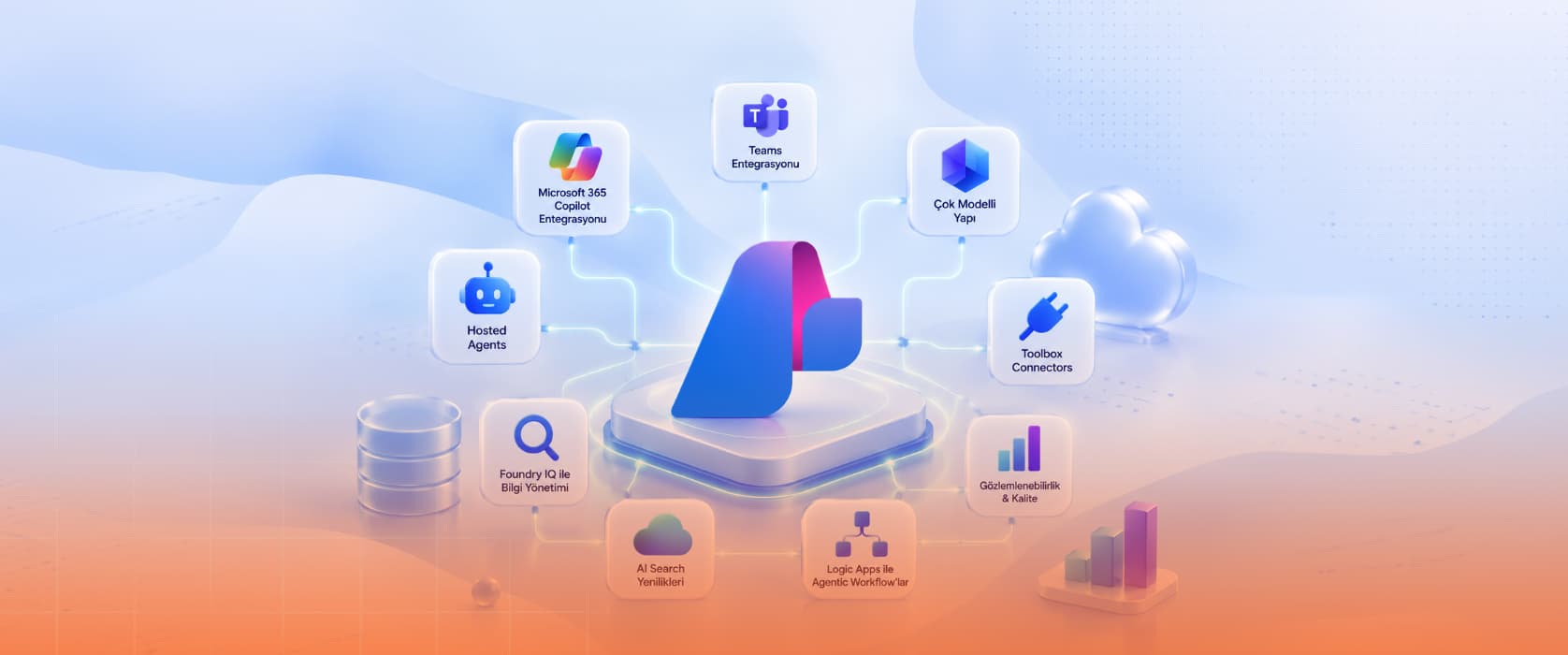
Azure AI Foundry Agents Can Now Be Published Directly to Microsoft 365 Copilot and Teams
One of the biggest enterprise requirements is making AI agents available inside the tools employees already use every day.
With the latest update, agents built in Azure AI Foundry can be published directly to Microsoft 365 Copilot and Microsoft Teams. Instead of managing separate integration processes for different platforms, organizations can use a single development flow to make agents available across the business.
This is especially valuable for agents designed for IT support, HR, sales, finance and operations teams, where fast adoption by end users is critical.
Azure AI Foundry Continues to Strengthen Its Multi-Model Approach
Not every enterprise AI scenario needs the same model.
That is why Microsoft continues to expand the model ecosystem within Azure AI Foundry. With Anthropic Claude models becoming available for production use, organizations are no longer limited to OpenAI models and can manage different model families from a single platform.
This approach gives businesses more flexibility to optimize costs and select the right model for each workload.
Hosted Agents Shift the Focus from Infrastructure Management to Operational Efficiency
Building an agent is only one part of the journey. Running that agent reliably at scale is just as important.
With Hosted Agents, Azure AI Foundry can run agent infrastructure on Microsoft-managed services. Development teams no longer need to spend time on server management, runtime updates or scaling operations. Instead, they can focus directly on business value.
For organizations managing dozens or even hundreds of agents, this creates a significant operational advantage.
Azure AI Foundry IQ Opens a New Chapter in Enterprise Knowledge Management
High-quality data sits at the heart of every successful AI project.
Microsoft’s expanding Foundry IQ capabilities help agents access enterprise knowledge more accurately and securely through OneLake integration, Azure AI Search support, MCP-based knowledge sources and advanced content access mechanisms.
This moves beyond traditional Retrieval-Augmented Generation (RAG) patterns and helps organizations build a more centralized enterprise knowledge layer.
Toolbox Connectors Help Agents Become Part of Business Processes
Modern AI agents do more than answer questions. They also take part in business processes.
With Azure AI Foundry Toolbox Connectors, agents can communicate naturally with Azure services, Logic Apps, Model Context Protocol (MCP) servers and other enterprise systems.
This makes it easier to design scenarios such as data transfer between systems, approval flows and process automation.
Observability and Agent Quality Move to the Forefront in Azure AI Foundry
One of the most important questions in enterprise AI is: “Why did the agent make this decision?”
With its latest updates, Azure AI Foundry now offers more advanced monitoring and evaluation capabilities.
Trace Replay, visual execution flows and evaluation tools help developers analyze agent behavior in detail, detect issues faster and improve quality in production environments.
These capabilities are particularly important for AI governance in regulated industries.
Azure AI Search Updates Strengthen Enterprise AI Solutions
Azure AI Search has also received notable updates recently.
With OneLake integration, the general availability of Prompt Skill and Chat Completion Skill, Managed Identity support and Purview Sensitivity Labels integration, organizations can build AI solutions on more secure data access mechanisms.
These improvements offer important advantages for industries with strict data security and compliance requirements.
Azure Logic Apps Integration Enables End-to-End Agentic Workflows
The integration between Azure Logic Apps and Azure AI Foundry is another important development.
A business process can now be designed as a fully agent-based workflow: data from an ERP system triggers Logic Apps, an Azure AI Foundry agent evaluates the information, and automated actions are then taken in Microsoft Teams, Outlook or another enterprise system.
This approach brings AI-powered process automation into the natural rhythm of daily operations.
Azure AI Foundry is no longer focused only on building agents. It is becoming an integrated enterprise AI platform designed to connect agents with business systems, manage them securely, observe their behavior and scale them sustainably.
At PEAKUP, we believe enterprise AI transformation is not just about selecting the right model. Real value emerges when Microsoft 365, Azure, Fabric, Power Platform, Azure AI Search and Azure AI Foundry work together within a secure and manageable ecosystem.
In the coming period, competitive advantage will not belong only to organizations using the most advanced models. It will belong to those that can integrate AI agents into their business processes in a secure, scalable and sustainable way.