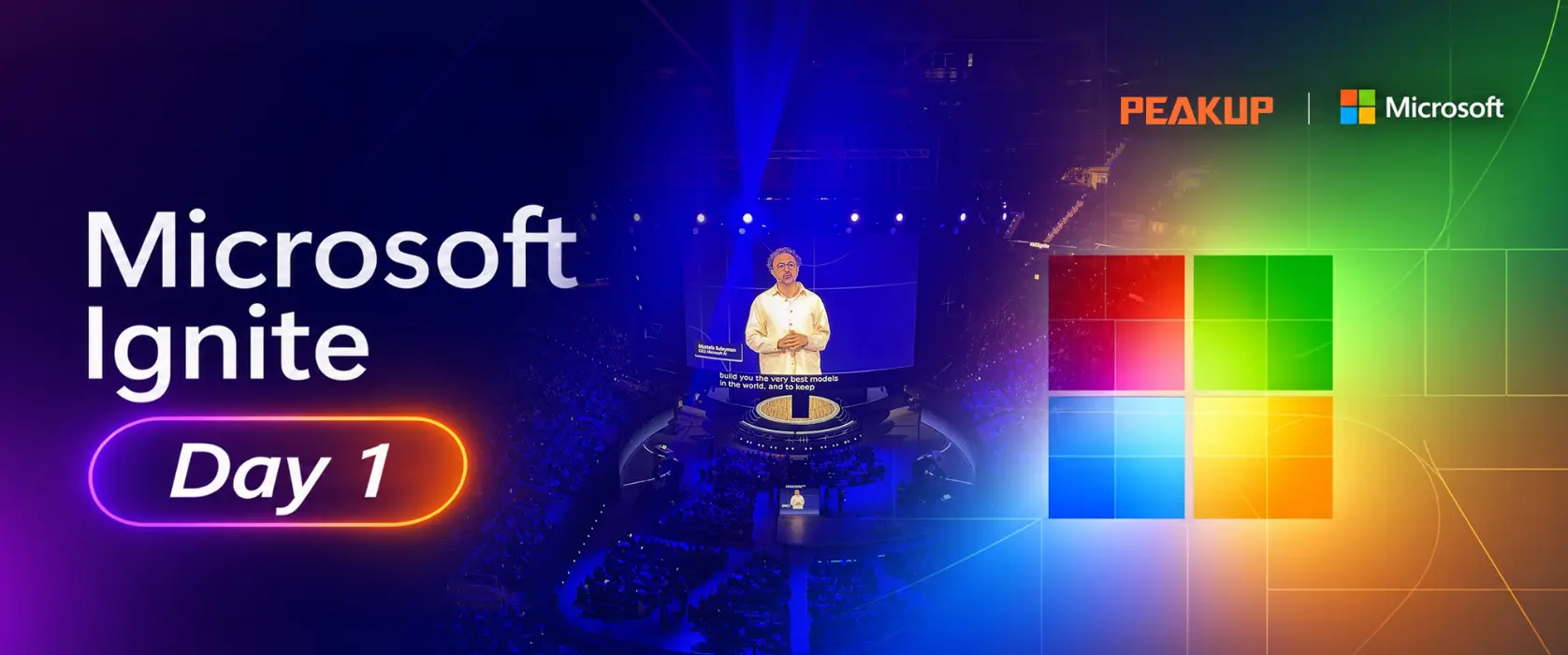


Day one of Microsoft Ignite 2026 brought major developments that point to the next stage of enterprise AI. The announcements show Copilot evolving from a conversational assistant into an agent platform that can take on work, Microsoft Fabric becoming the trusted data layer for those agents and applications, and Agent 365 emerging as the management layer for governance, cost, security and measurement.
From the sessions and announcements the PEAKUP leadership team followed on site in San Francisco, one early conclusion is already clear:
In the next era of enterprise AI, real value will come from making agents a secure, manageable and measurable part of everyday work.
The event is still under way. This is therefore not a final assessment of Ignite 2026, but a day-one view of the most important developments, our first impressions from the event and the opportunities we see for organizations.
The enterprise AI agenda is also changing. The question is no longer simply which product or license to invest in.
The real questions are:
- Which business processes should use agents?
- How should enterprise data and context be made available to agents?
- How should people and agents work together?
- How should agent identities, access and risks be governed?
- How should the business value of AI investments be measured?
We assess the standout day-one developments across Copilot, Microsoft IQ, Fabric, Agent 365, security and application development through a PEAKUP lens.
What do the announcement statuses mean?
Three availability labels matter when evaluating the news from day one:
- GA — General Availability: Ready for production use and available to deploy today.
- Preview: Suitable for pilots and proof-of-concept work. Scope and conditions should be reviewed before production use.
- Frontier: Available for early access through the Microsoft Frontier program.
This distinction helps organizations translate announcements into action. GA capabilities can move into implementation planning, while Preview and Frontier developments are better approached through controlled pilots.
Copilot: From asking questions to delegating work
Day-one Copilot announcements showed Microsoft 365 Copilot becoming a broad platform that brings conversation, document creation, task delegation and continuously operating personal agents into one work experience.
For users, the shift is significant: Copilot’s core value is moving from answering questions to taking on work.
One starting point, a continuous work experience
Copilot Home brings Chat and Cowork together in a single starting point. With Word, Excel and PowerPoint working inside the Copilot app, users can move from conversation to document, and from analysis to action, without getting lost between tools.
Files created there are saved to OneDrive and inherit existing sensitivity labels and compliance controls, preserving enterprise safeguards while productivity increases.
Auto can recommend the Cowork experience for complex tasks and use Microsoft-Decision-1.1 to help select the right model for different parts of the job. Larger models are used only where needed, supporting more controlled token costs.
This addresses two important adoption barriers:
- It reduces the user’s “Where do I start?” question.
- It routes the right task to the right model instead of using the largest model at every step.
Copilot Cowork brings agents into everyday work
Copilot Cowork can use enterprise signals supplied by Work IQ to suggest tasks worth starting. It can also bring declarative agents that organizations have already built into the daily flow of work.
This matters for the return on agent investments. Building an agent does not create value by itself; it must enter employees’ daily routines, be used consistently and support a tangible business outcome. Cowork may help solve the visibility and adoption problem of capable but underused agents.
Autopilot and the era of the always-on personal agent
Autopilot is positioned as an enterprise personal-productivity agent with its own identity, memory and tool access, able to operate over extended periods.
- It can monitor ongoing workflows.
- It can execute recurring tasks.
- It can receive requests through Teams.
- It can act under its own agent identity.
- It can operate within enterprise security and management controls.
The change goes beyond automation. The employee moves from doing every task directly to defining the work, delegating it to an agent, guiding the process and reviewing the outcome. Recording actions under the agent’s own identity preserves auditability as autonomy increases.
Shared context with Copilot Workspaces
Copilot Workspaces brings teams, shared content and ongoing work into one environment. Copilot can summarize what changed, what remains unresolved, which actions are pending and the project’s current status. For long-running initiatives spread across teams, files and meetings, this can reduce information loss and the time spent reconstructing the latest picture.
Microsoft IQ: Giving agents enterprise context
One of day one’s most strategic themes was how to equip agents with enterprise context. The quality of an agent’s output depends not only on the model, but also on how well it understands an organization’s data, expertise, ways of working and business relationships.
Microsoft IQ brings several context layers together:
- Work IQ: work context, organizational relationships and productivity signals.
- Fabric IQ: enterprise data, metrics, entities and business relationships.
- Foundry IQ: unstructured enterprise content.
- Web IQ: current information from the web and the real world.
These layers allow agents to draw on organization-specific context rather than general knowledge alone. Microsoft IQ requiring no new SKU or subscription makes it a meaningful way to build a new intelligence layer on top of existing Microsoft investments.
Work IQ opening to OpenAI and Anthropic also indicates that enterprise context will not be limited to Microsoft agents. Different models and AI tools may use the same context within permissions set by the organization.
What will set organizations apart is not access to models that everyone can use, but the enterprise context those models can understand.
Dynamics 365 and Salesforce integrations reinforce this direction. Sales, finance and operations teams can work through Copilot without losing the context held in their business systems, moving Copilot from a separate chat layer to a platform embedded in real processes.
Microsoft Fabric: The trusted data layer for AI and applications
Day-one announcements showed Microsoft Fabric moving beyond analytics and reporting. It is becoming the trusted data and backend layer for Copilot, agents and applications built through natural language.
The data platform no longer analyzes only the past. It is becoming an operational foundation where agents run and applications are created.
Fabric IQ and one version of the truth
Fabric IQ combines OneLake data, Power BI semantic-model metrics and ontology structures so people and agents can use the same enterprise definitions. Whether a user asks through Excel, Copilot, ChatGPT or Claude, concepts such as revenue, customer, product and profitability should not change.
Whichever AI tool the user chooses, the organization’s single version of the truth must remain the same.
Fabric IQ should therefore be viewed not simply as a feature, but as a shared business-context layer that extends semantic-model investments across AI experiences.
From monitoring reports to taking action
The data apps approach announced for Power BI Pro allows users not only to view data, but also to enter information, update records and write changes back to source systems. Planning, approval, data collection and operational updates can be digitized within the existing Power BI experience.
Fabric apps, meanwhile, helps business teams build applications connected to enterprise data and access controls without creating a separate backend. This can replace unmanaged shadow IT with centrally observable and governable applications.
Agent 365: Managing AI cost and business value
As agents spread across the enterprise, they create a new management and financial discipline. Leaders need to know which agents are used, what each service or model costs, which outcomes an agent supports, what should be scaled or retired, and how much time and value AI investments create.
FinOps for AI
Agent 365 FinOps for AI is designed to bring spending across Cowork, Copilot Code, Copilot Studio, Autopilot and the Work IQ API into one view. Organizations can set spending limits and alerts, forecast usage and cost, analyze spending by user, agent, service or model, and build chargeback models for business units.
Business Analytics goes beyond usage volume by including outcome-oriented indicators such as success rate, user satisfaction and hours of work supported. This allows AI budgets to be explained to management and finance teams through measurable evidence rather than assumptions.
AI investment is moving from an experimentation budget to a manageable business portfolio.
Security: Scaling agents with confidence
Agents are moving to the center of enterprise security architecture. They do more than retrieve information: they use tools, interact with systems, make decisions and, under defined conditions, take action.
Security is not a barrier placed in front of Copilot and agent adoption; it is a prerequisite for scaling them safely.
Agent 365, Microsoft Entra, Microsoft Intune, Microsoft Defender and Microsoft Purview bring agent identity, access, tools, data and risk into a shared management model.
Data security and oversharing controls
New Microsoft Purview controls aim to restrict Copilot from referencing sensitive files that have not yet been labeled. Extending prompt protection to attachments and linked files can reduce oversharing, one of the biggest barriers to Copilot programs, and help organizations begin a controlled rollout without waiting for a comprehensive labeling initiative to finish.
Agent governance
Agent 365 governance provides visibility into tool access, plugin and skill permissions, MCP server connections, ownerless agents, inactive agents and shadow agents built outside approved controls. That visibility helps reduce agent sprawl.
Microsoft Perception and agentic defense
Microsoft Perception brings specialized security agents into a shared defense loop:
- Red agents discover and validate potential attack paths.
- Blue agents classify alerts and investigate attacks.
- Green agents identify critical exposures and coordinate remediation.
As agents collaborate across discovery, investigation and remediation, security teams continue to set priorities and approve critical actions. Human expertise is not removed; it is focused on the decisions that matter most.
As agents become more autonomous, governance does not diminish. It becomes more visible, continuous and systematic.
Apps and Automation: Natural-language creation, centralized management
Day one also revealed a clear direction for application development and automation: business teams’ need to build quickly and IT’s need for security, governance and lifecycle control no longer have to compete.
Copilot Code
Copilot Code enables users to create dashboards, trackers and applications through natural language. Running those applications in a secure tenant sandbox and managing them through the Microsoft 365 admin center can help citizen development scale without leaving IT oversight.
Copilot Managed Runtime
Copilot Managed Runtime provides a common operating and management layer for applications, agents and workflows built in Cowork, Copilot Code, Copilot Studio and compatible third-party tools. Fabric databases, storage and data APIs can serve as the backend when needed.
The important question becomes not which tool created an application, but where it runs and how it is governed. Makers and professional developers can work on one platform while security, hosting and lifecycle controls remain intact.
Windows 365 for Agents can also open legacy applications without APIs to agent-based automation. Running agents on managed Cloud PCs may move traditional RPA scenarios toward a smarter and more secure model.
The PEAKUP perspective: The day-one picture
Viewed together, the announcements point to a larger transformation:
- Copilot is evolving from a chat application into an agent platform.
- Microsoft IQ gives agents enterprise context.
- Microsoft Fabric becomes the trusted data layer for agents and applications.
- Agent 365 unifies cost, usage, governance and security.
- Copilot Code and Managed Runtime scale natural-language creation within enterprise controls.
- Entra, Purview, Defender and Intune create a new security architecture for a non-human digital workforce.
For PEAKUP, the direction is clear: the decisive factor in enterprise AI transformation will be data-driven, integrated experiences designed with governance in mind.
We help organizations identify Copilot and agent use cases, prepare data for AI, build semantic models and ontologies, develop secure pilots, design human-agent collaboration, govern agent identities and access, drive adoption, and measure cost and business value.
Microsoft Purview DLP and Agent 365 governance provide a strong foundation for a Secure AI Readiness approach. Agent 365 Business Analytics can also move adoption programs beyond usage rates to hours supported, user satisfaction and business outcomes.
After day one: The next era is not simply about building more agents
An agentic enterprise is not an enterprise with more agents. It is one that brings the right data, enterprise context, security, governance and measurable business value into a single operating model.
Success will depend on applying agents to the right business problems, grounding them in trusted and meaningful data, preserving human oversight, addressing identity and security from the start, and measuring cost alongside value.
Ignite 2026 is still under way. We will continue to assess this day-one picture as new announcements emerge and our conversations on the ground develop.
PEAKUP will continue helping organizations define Copilot and agent scenarios, prepare their data for AI, run secure pilots and turn AI investments into measurable business value.
Throughout Microsoft Ignite 2026, we will keep sharing the most important developments and our notes from the event through the PEAKUP perspective.